Phase V
Documenting Project Outcomes and Recommending Revisions
Summary of Data
Assessment data from this study was collected and analyzed to identify the level of student learning and their mastery of the learning objectives. Six students were chosen to take part in the technology intervention program. The student data occurred in three ways:
a) Pre/Post Assessments: students completing a pre- and post-assessment which consisted of 40 random basic multiplication facts from 1 through 12,
b) Quizzes: students completing weekly basic multiplication quizzes consisting of 25 facts of one multiplication fact family and,
c) Visual Record: students creating a visual record of their progress and predictions by recording results on a chart as a bar graph.
The first set of data collected were the scores on the 40 point pre-assessment. The post-assessment was a duplicate of the pre-assessment and the resulting scores were then compared. The difference between these two scores was calculated and the growth in learning compared on an individual basis.
Student Initials Pre-test Percent Correct Post Test Percent Correct
Student 1 SW 2% 11%
Student 2 LW 16% 24%
Student 3 DD 15% 21%
Student 4 CH 15% 25%
Student 5 NW 22% 28%
Student 6 JC 22% 28%
The following pie charts are graphic representations of the data collected for the 40 point pre- and post-assessments for each student. The pie charts show each student's initials followed by "Possible" which indicates 40 possible answers, "Pretest" is the amount the student scored correctly on the assessment before interventions and "Post Test" is the amount the student scored correctly after taking part in the technology intervention:
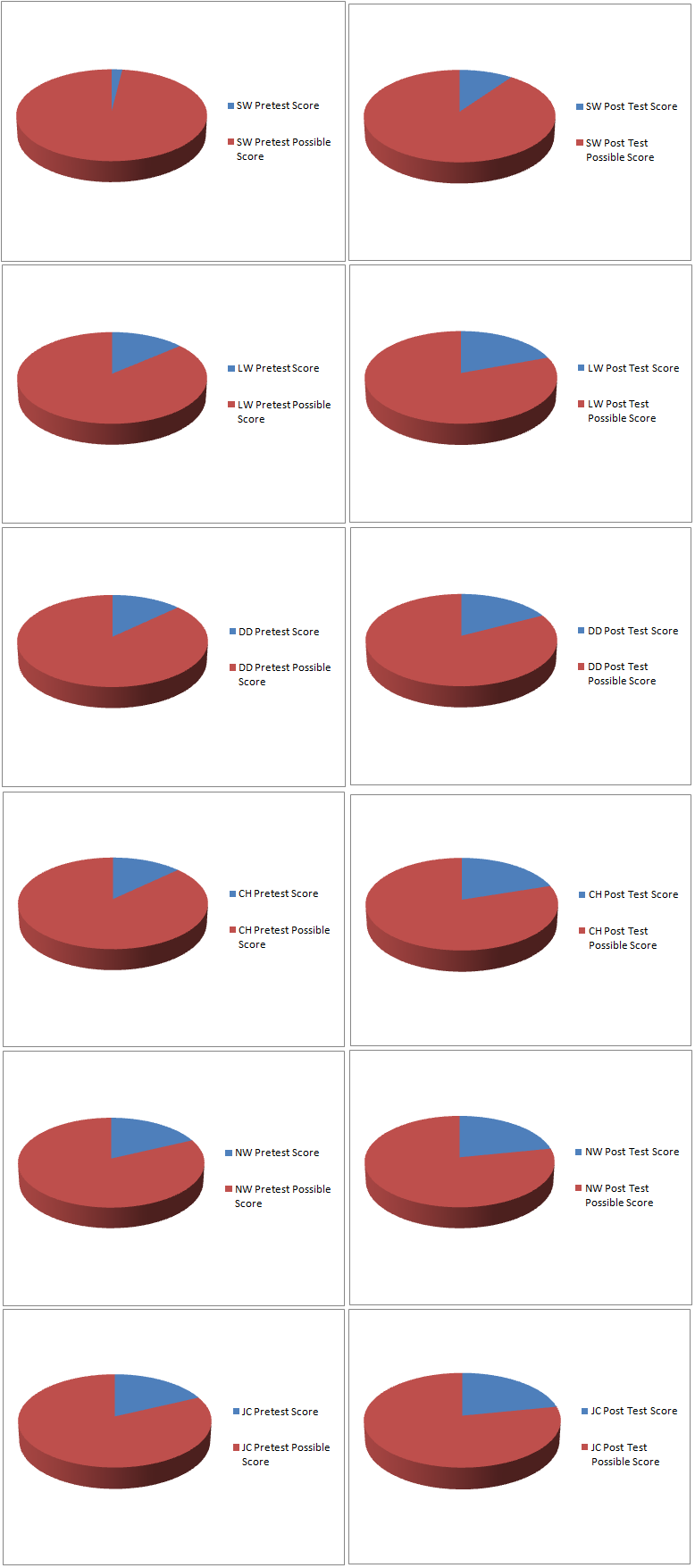
Implications of data results between the pre- and post-assessments are that students have slightly improved their knowledge of multiplication and of basic facts.
Quiz Data
The next set of data collected and analyzed came from the weekly 25 point quizzes given as formative assessments to gauge student learning growth, their progress toward mastery of the skill, and to see how well their performance met the stated objectives. These quizzes were administered only after students were given 75 minutes per week of technology-based intervention using online resources which focus on practicing of basic multiplication facts.
The pdf link below shows the student created graphs called "My Fact Check Progress Graph" along with an interpretation of the quiz data indicated on these graphs. Please click on the pdf file entitled "Phase v interpreting data" beneath the image below.You will be able to see the graphs and my analysis of the data presented here.

|
Phase v interpreting data.pdf Size : 642.683 Kb Type : pdf |
Results
The following objectives are outlined in Phase II of this project:
Objective 1: By completing the weekly online activities the students will demonstrate their ability to compute multiplication problems by correctly answering 25 multiplication questions on a paper and pencil quiz given weekly in order to exercise the skills of multiplication with 95% accuracy.
Prior to technology instruction, all students in this study were not making significant gains on multiplication quizzes. After implementing the technology solution, all six students demonstrated mastery of the objectives 94% of the time. Of the 18 total quizzes taken by the six intervention students, 17 of the quizzes were passed with 100%. While five students consistently scored 100% on each quiz, one student did not yet meet the objective on one quiz. In this instance further practice and re-testing is indicated.
Objective 2: At the conclusion of the computer based intervention program the students will be able to demonstrate their ability to compute multiplication problems of basic multiplication facts from 1 through 12 with automaticity as demonstrated on a 40 question paper and pencil final exam and with accuracy of 90%.
In the experimental group, all six students improved their scores from the pre- to the post-test. However, none of the six students met the objective. The time allotted for this intervention program spanned three weeks. The failure to meet this objective is due to the limited amount of time the students had to practice and learn on the computer. I have confidence this objective will be met with further implementation of the program and when they take their final test is June.
Objective 3: At the conclusion of each weekly quiz, given as part of a technology-based intervention program, the students will create a graph charting their growth and progress toward their ability to compute multiplication problems of basic multiplication facts from 1 through 12 with automaticity as demonstrated on a 25 question paper and pencil quiz given weekly.
Each student demonstrated a positive change in attitude on the recording graph they created. Each consecutive prediction the students made after beginning the technology intervention showed an increase in the number of answers they believed they would get correct on the next quiz.
The students in the experimental group had a more positive reaction to general math class work and felt more confident with answering questions during math class discussions. For instance, student SW was always reluctant to take part in any class discussion. After spending several weeks in the technology intervention program, she now routinely raises her hand and offers answers in class.
In addition to the positive effects the intervention program has had for the six students in the general education math class, students in the program had positive experiences using the computer to practice their multiplication facts and looked forward to practice time. All six students routinely asked if they could practice on their multiplication on the computers at random times throughout the day (during indoor recess, during library time, or when a language arts intervention class was cancelled).
Discussion
Implementing a technology program to help students practice and understand multiplication was beneficial in helping students learn. The program allowed students to get immediate feedback to the correct or incorrect answers and gave information about what multiplication is and how to think about patterns and strategies that would help them learn. With this immediate feedback and deep explanation, the students were able to practice their multiplication skills effectively. Students appeared to be on task 95% of the time. The gains made through the use of computers as an intervention is evident in the growth and progress of the six intervention students and while they met only two of the three identified objectives, the strength of the program warrants further study.
The implications of the data suggests a more positive attitude toward learning after students took part in three weeks of this technology based solution. Student's discussion and reactions showed their gratitude that they now have this kind of technology learning support they know they need to help them be successful with math. Students in the group acknowledged the fact they needed to know how to multiply to be successful in math class and yet they did not have this skill prior to the technology intervention. Once I shared the website with parents, they too seemed happy to have this access to real support for their child's learning at home. One parent expressed gratitude by calling to say, "Finally my son has a great way to practice his facts at home--the flash cards just weren't working."
Revision Recommendations
After reviewing the data from this research project some suggested changes to procedure and implementation is indicated:
1. Begin the intervention program earlier in the school year. The success rate for this group of students is encouraging, especially in light of the limited amount of time they spent using technology as an intervention. It is suggested that students begin the program at the first sign of difficulties with multiplication for the best chance at successfully meeting the objectives.
2. Devise and implement a pre- and post-program survey to gauge students attitudinal changes. It is important to note that while a survey was not used in this technology program, the positive impact it had on the students was evident in the change in their demeanor and with their predictions for future success. An online survey program could be created with the use of Surveymonkey.com which would offer hard data of students attitudes toward learning. As Roblyer and Doering (2013) explain, "When the desired outcome is improved attitudes, teachers design a survey in Likert scale format or with a semantic differential" (p.61). They further explain, a Likert scale format is a series of statements that students us to indicate their degree of agreement or disagreement (Roblyer & Doering, p. 61). For example:
I like to solve problems using multiplication. (Circle one of the following numbers.)
Strongly Agree Agree No opinion Disagree Strongly disagree
1 2 3 4 5
3. Share the dynamics of the program with other interested teachers. Once teachers heard about the multiplication intervention program using technology, they expressed interest in implementing it with their own students who were struggling with multiplication. Sharing the program could be done by inviting all interested teachers to a demonstration and having a dialogue about the website, how the program could work in their own classrooms, and exchange ideas for improving the program.
4. Model student expectations prior to the start of the program. Take time to discuss with the students what behaviors are appropriate during their time using the computers. Have students act out what to do if they have a question or if others try to interrupt their learning. This type of pro-active demonstration time can be vital to the success of the program because it shows students the behavior expectations and lessens off-task behaviors.
5. Involve parents in the project. Have a discussion with the parents of each child taking part in the intervention and thoroughly explain the projected outcomes. Getting parents involved assures students will practice using technology at home as part of their nightly homework responsibilities and improves their chance of meeting the identified objectives. If students do not have access to a computer in their home, measures might be taken by the parent to allow practice time on a computer through the local library system.
Sharing with a Larger Community
Other teachers in my school have expressed an interest in the math intervention project. These are ways for sharing this project idea with others teaching professionals:
- Share this capstone project so they can see the learning issues, objectives, learning outcomes, and overall strength of the math intervention program
- Create a school based wiki where teachers can share lesson resources and ideas based on their grade level.
- Create a grade level website where each teacher contributes resources for students to use for lesson practice and learning.
- I can provide a professional development session to share information about technology based learning ideas with other teachers and with administrators.
Future Research
Throughout my observations, I discovered many of the six students in this group wanted to practice their multiplication facts using the online games I offered on the intervention website (such as those found at multiplication.com). While later in their practice sessions, I allowed this form of practice and I noticed the students did not seem to be learning as well as when they were using the power point presentations as “drill and practice” kinds of learning or direct instruction (such as those at learnzillion.com). Based on this observation future research might include:
- Providing two sets of intervention groups. Conducting the study with one group using only learning based activities with lessons and practice which are presented with power points, lesson practice, and avatars teaching multiplication. The second group would spend the same amount of time with all the same conditions as group one. However, group two would practice specifically using interactive games to learn their multiplication facts. It is my hypothesis that students who spend their practice time on game-like activities may be more engaged in the activities but when it comes to learning multiplication facts, they will not learn as quickly as the group who uses more formal methods of learning (such as direct instruction and practice activities).
The success of this project is encouraging and further study is indicated which would include other forms of technology intervention. I would like to develop this intervention project to span other subject areas and more math objectives. The idea of using technology to expand the project would be organized in the following way:
- Using the form a data analysis which already exists at my school we can pinpoint students who are struggling with particular concepts (a system already in place).
- Once the struggling students are matched with the skill they lack, lesson resources could be located online to match these skills and used to help strengthen their learning deficits.
- These resources would be placed on an intervention website and time allotted each day for intervention time—much as my multiplication intervention program was organized.
This way, instructional technology could be used in the classroom (and at home with parental support and guidance) beginning at the first sign of a learning issue, whether the issue is language arts or math. Formative assessments could be implemented and their progress gauged by examining their learning growth on other class assessments such as Rigby Benchmark reading tests, Performance Series reading tests, and County Assessments.
References
References for Phase V are located on the References page of this website.
